 Profile HelpIntuit
How to extract log files from ProFile
by Intuit• Updated 11 months ago
Log files are a recording of ProFile activity. Often, they can provide important insight into the software and computer behaviour if there is an issue or error. They may be requested by a support agent to assist in troubleshooting an issue.
| ‣ Extract log files |
| ‣ Capture recent logs |
| ‣ Extract EFILE report files |
| ↳ Extract T3 & FX *.XML files |
| ‣ If the ProFile application cannot be accessed |
Extract log files
- Open ProFile.
- Select Environment... from the Options dropdown menu. The Environment Options window will display.
- Select the System tab.
- Check the Static Logs checkbox in the For Technical Support Only section.
- Select OK.
- Attempt to replicate the error; the log files will capture and document the error process.
- Select the Support > System Information... option from the Help dropdown menu. The System information window will display.
- Select Save. The Save As window will display.
- Navigate to the location/folder to save the log files.
- Select Save.
Two files (gpinfo.txt and LogFiles.dat) are saved to the selected location.
- Select Close in the System information window.
- Select Environment... from the Options dropdown menu. The Environment Options window will display.
- Select the System tab.
- Uncheck the Static Logs checkbox in the For Technical Support Only section.
Capture recent logs
Note: The profile.log and profile.static.log files are located in the AppData folder. This is a hidden folder and it's necessary to search and identify it.
- Close ProFile.
- Open a Windows Explorer window.
- Enter the term %APPDATA% in the top menu bar and press Enter.
- Navigate to the following directory: C:\Users\[USER NAME]\AppDataRoaming\ProFileLogs.
- Sort by Date modified.
- Copy the three most recent ProFile_[DATE].log files.
- Attach the three files to the escalation.
Extract EFILE report files
Note: *.TAX, *.EAX and *.SLG files are XML files created by the software to transmit EFILE information to the CRA:
- *.TAX = T1 returns
- *.EAX = TP1 returns
- *.SLG = Batch EFILE
- *.XML = FX slips and summaries and T3 slips and summaries
Note: These XML files are not available for T2 Corporate returns.
Extracting *.TAX, *.EAX & *.SLG files
These files are located under the T1 EFILE directory in ProFile.
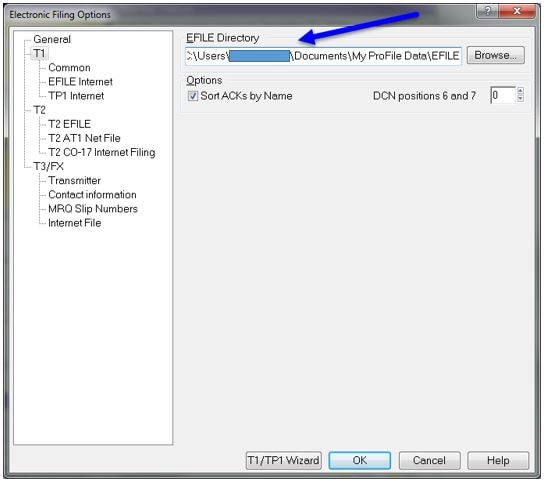
- Select Options under the EFILE dropdown menu in ProFile.
- Select the option T1 in the left pane.
- Review the path listed in the EFILE Directory field. This is the location where the *.TAX, *.EAX & *.SLG files are located.
Heads up! By default, this location will be C:\Users\[USER NAME]\Documents\My ProFile\DataEFILE.
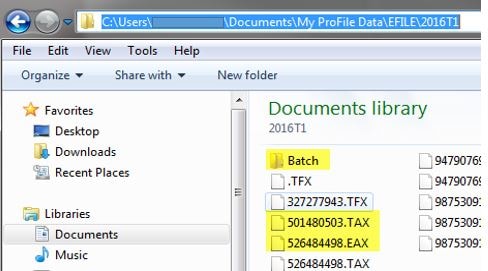
ProFile automatically organizes the .TAX and .EAX files by SIN and year and includes a Batch folder inside of each year for the .SLG files. ProFile overrides files each time an attempt at EFILE is made.
Extract T3 & FX *.XML files
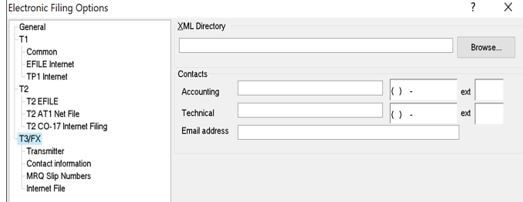
ProFile saves the XML transmission files with the return or to a pre-set location set by the user under EFILE > Options > T3/FX.
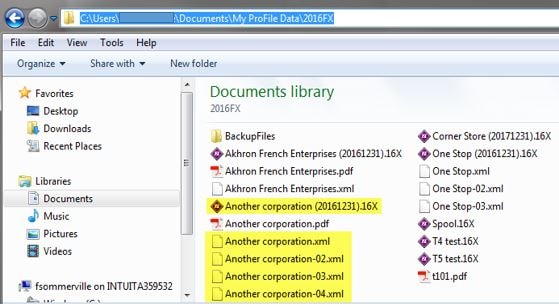
The XML file uses the name of the trust or Entity.
Note: ProFile doesn't override previous XML files, but instead tags a number to the file name.
If the ProFile application cannot be accessed
- Navigate to C:\Program Files (x86)\ProFile.
- Double-click on the file SystemInfo.exe; the System Information window displays.
- Select Save. The Save As window displays.
- Browse to the location/folder to save the log files.
Two files (gpinfo.txt and LogFiles.dat) are saved to the selected location.
- Select Save, and then select Close.
Note: Also include if available, the profile.log & profile.static.log files (see section Extracting log files above).
More like this